Showing posts with label real women have curves. Show all posts

Tuesday, March 2, 2010

It would be inappropriate to say, "This makes me want to vomit."

At Shad (my work gym) yesterday, I saw a flyer for "Bridal Boot Camp." Do. Not. Want.

This morning, Scott stopped by my desk before class. He saw the "Shad March Events" flyer on my desk and asked me what I thought of Bridal Boot Camp (which was one of the ones listed there). He read me the description (which I hadn't looked at before).
Bridal Boot Camp will help you get into tip-top shape for your wedding day. It works because there's a deadline and no room for mistakes! This will be a total immersion style of training, with twice a week sessions and access to your trainer, ensuring accountability and success. Your trainer will motivate and train you the way you want to be trained. Get slim, strong, and sexy with emphasis on building symmetry and balance.
I said I understood the desire to look your best for this really important event which will be immortalized in photos but I'm uncomfortable with the idea of weight as a measure of health, and the idea that you have to be a certain shape to be attractive -- "get skinny and fit because no one will love you otherwise; oh wait, you're getting married, so someone already loves you!" I said my feelings on this are strong and probably unsurprising. He was in agreement with my feelings, which I appreciated.

I told him a little about an article I read yesterday -- about "fat talk" and how women "race each other to the bottom." (I told him I felt like this was one of the ways I failed at being a girl and that I was really okay with that. Though yes I'm sure I've absorbed some of that acculturation.)

Here's the excerpt I was gonna post yesterday but didn't have the brainpower for:
One of the things that I am really into studying, lately, is adolescent female friendship. It is this hugely complicated and fascinating thing, wherein girls create immensely powerful spaces of resistance, but also put each other through Patriarchy Boot Camp, and I am starting to hold the opinion that studying it extensively will reveal to you the Secrets of Life. I won’t go into all of that right now! But I will say that I have, recently, been reading a book called Odd Girl Out: The Hidden Culture of Aggression in Girls, by Rachel Simmons. One passage in this, which grabbed me and blew my mind and suddenly made about a thousand troubling incidents way more easy to understand, was about how female bullies pick their victims. The author interviewed a whole bunch of girls about this, and she came up with a really good, really obvious answer. So, do you want to know how they pick their victims?

They pick the girl who seems the most confident.

Yes, that’s really it! In the particular seething cauldron of insecurity, unhappiness, and fear that is female adolescence, girls tend to feel shitty about themselves for about a million reasons, and to think that they need outside approval – from friends, from boys, from the culture at large – in order to be worthwhile. But if a girl seems not reliant enough on outside approval – if she doesn’t hate her body enough, if she’s too successful at getting guys to like her, if she’s not interested enough in getting guys to like her, if she thinks she’s smart or cool or worthwhile or pretty (or if she just is smart or cool or worthwhile or pretty, and it’s pronounced enough for the people around her to take notice) – then the wolves start circling. Because they’ve all been bullied, too; they’ve all been undermined; they’ve all made the mistake of standing out, at one point or another, and they’ve been punished for it. And now, because they feel like shit about themselves, you have to feel like shit, too. A girl who doesn’t feel like shit is a threat to the entire social order, the extensively complicated and crappy system whereby women have to earn their way into a pretense of self-esteem by getting enough approval from other girls or from other outside sources in general.

What girls learn to do, in order to survive in this particular dynamic, is to race each other to the bottom. It lasts for a lifetime. They maneuver, hiding the urge to matter and succeed under an appropriately self-loathing demeanor, so that they can get ahead and climb up without ever appearing to do it.

For example: have you ever gotten the Complinsult? It is a wondrous and immensely complicated thing, the Complinsult. Here’s one of the best I have ever received, which I keep close to my heart: “Your outfit is amazing! I think it’s so great that you can wear that out in public. I’d never have the nerve.” The words are saying “I suck and you are awesome,” and yet? That is EXACTLY THE OPPOSITE of what it means. Guys do this, too, sometimes, but typically only guys who are really adept at social maneuvering; girls tend to learn it earlier, and to have it down better, and to use it more, if my own personal experience is any indicator.

Or: the Fat Talk. You know about the Fat Talk, right? Lots of people have written about the Fat Talk already. For years, I thought this was some grody stereotype that you only found in male stand-up comedians’ routines about how women are awful. But then I met women who actually did it: the thing where, before ordering dinner at a restaurant, you all talk about how you should order this and you absolutely cannot order that, because you are so disgusting and you cannot stick to your diet and eating a cheeseburger will literally send you right straight to hell, and if you are the girl who straight-up says she wants some nachos so covered in cheese and guacamole and various meats that they might as well not even have any chips involved – just a big mess of meats and milk fat and squished-up avocados, that is the experience for which you are aiming, and also it would help if the entire thing had sour cream all over it – well, you just might have earned yourself a Complinsult about how brave you are with your dietary habits, young lady.

The weird thing is that, in this scenario, it seems not to ultimately matter whether you get the cheeseburger or the nachos or whatever: what matters is the extensive ritual of saying bad things about yourself, and contradicting other ladies about the bad things they have said about themselves, and giving each other permission to order the nachos, before they’re ordered. And if you don’t get permission to order the nachos, if you’re the one girl at the table who doesn’t get contradicted when she says she’s fat and shouldn’t be allowed to eat what she wants, then you know something is up. You know someone at the table, or maybe everyone at the table, has a problem with you. Which is why you don’t place your order without doing it: for a long time, I thought I was just demonstrating my good body image by ordering a cheeseburger and not participating in the Fat Talk, and then I sort of figured out that I was straight-up declaring that I was so hot I got to do whatever I wanted and was too insensitive to appease the body insecurities of my friends, who were (my actions declared) less hot than myself. I still think the Fat Talk is destructive and body-hating and stupid, and I don’t want to do it, but the way I get around it is to talk with the girls I have lunch with about why I think it’s destructive and body-hating. Not to just bypass it. Because that’s how self-esteem, and self-promotion, and social status, tend to work with girls: it’s a series of very subtle interactions in which you say you’re not good enough so that other girls can tell you that you are.

Saturday, August 22, 2009

"More grains. Less you."

Excuse me, WHUT?

I was just channel-surfing 'cause I don't have the energy to think, and there was an ad for whole grain cereal, saying it can help you lose weight ("people who eat more whole grains have a healthier body weight" -- define "healthier body weight") and I'm used to that sort of stuff, but then their tagline was "More grains. Less you." 0.0

Tuesday, June 30, 2009

[Christianity] perfected bodies and (wedding) feasts

Shapely Prose's A Sarah posted:
One of the reasons I grudgingly remain a Christian, is because of a particular story that Christianity tells about bodies. Now, I hardly need to point out that not all the stories Christianity has told about bodies are good ones. A lot of them are crap. Maybe most of them; I don’t have an exhaustive understanding of Christian stories about bodies, but of the ones I come across, most are terrible. But there is, I think, a strand of the Christian tradition that is very body-affirming. For example: You might not know this, but there’s actually good reason for viewing the notion of a “soul” going to “heaven” as an interloper in the Christian tradition. Well, maybe “interloper” is too strong. But many theologians would say that, at best, it’s a belief that’s become an unhelpful distraction simply by being so focused upon. (Like, it actually doesn’t say in the historical canonical creeds that Christians’ souls will go to heaven when they die; it says only that Jesus was resurrected from the dead and then ascended into heaven, where he’s hanging out until he comes again.) (Er, I’m paraphrasing.)

Arguably, the FAR more consistent and long-established Christian belief about life after death is EXACTLY NOT that some immaterial vapor of selfhood will go into a happy place in the sky. Rather, it’s that our bodies will be resurrected and perfected.

Aieee! Perfect bodies. I’ve gone to church since I was a wee tot, and have now made a job of it — and yet when I hear about bodies being “perfected,” what springs to mind is not the Christian belief in the resurrection of the dead. No, it’s diets. It’s bikini season. Clear complexion products and spray tan and so forth. I fill with dread and anxiety and self-loathing.

But in the Christian theological sense, “perfected bodies” means mostly that our bodies won’t be in pain or die again. (Well, you have people like St. Augustine who also specified that everyone would be 33 years old in the resurrection, but that’s sort of an academic point.) More interesting than what the bodies won’t be, is what they will be, according to this particular flight of the Christian imagination. Namely, they will be ours. Recognizably. They will be physical bodies, the same ones we have now, just… transformed, somehow. They’ll be even more what they are now, more alive, more there. Their longings and yearnings will be fulfilled and satisfied. The delightful tangibility and vulnerability that comes with being fleshy won’t go away, but it won’t any longer be an occasion for danger and harm. It has even been speculated by at least one Christian theologian (and yes those are weasel words, and no I can’t remember who said it but I swear it’s in my seminary notes!) that our perfected bodies will retain their scars. The reasoning was that it makes sense that anything which testifies to suffering’s having been overcome will be preserved.

And what’s one image in the Christian tradition that has consistently been used to describe this new, redeemed, embodied life that awaits? Obviously not immaterial souls becoming harp-playing angels on clouds. Nope nope nope. A feast. A feast, where nobody is left out and everybody has enough. A feast where – if I may extend the image in a manner I think is faithful to it – there are no good foods and bad foods… no popular table and no nerds table… no foods that look gorgeous on the plate but are the result of cruel and world-killing technology… no need to make eating into a locus for control in the hopes of finally, finally being worthy of love. Just a beautiful, intimate, abundant, joyful, and peaceful meal with your close circle of friends. Except that the circle is extended to every creature, and the Holy One is sitting with us at the table too.
She goes on to talk about some of the ways in which the "wedding night" imagery is problematic and then to her great credit says:
Ah, that’s where I see the whole “ordered appetite” thing come in. And, you know, I can *almost* cut my tradition some slack here. I mean, if you’re saying that both gastronomical hunger and its fulfillment, and sexual longing and its fulfillment, reveal something about the very goal of the whole cosmos… well, suddenly, it seems pretty important to put in a bunch of provisos about how there are right and wrong ways for those appetites to be ordered. Because we don’t want to say that just EVERYthing that someone might theoretically do sexually, or EVERYthing you do related to your meals, is redemptive and good. A meal can be the occasion of exclusion and harm, even accidentally. So can sex. So can a bunch of other embodied longings.

Well, better make a whole bunch of rules to make sure that people only do the right things with their appetites, and not the wrong things, right?

Uhhh, sure, go ahead. Make a list of ordered and disordered appetites. And rules. And good people and bad people. And good bodies and bad bodies. Knock yourself out. EXCEPT REMEMBER THAT a big horking part of the Judeo-Christian narrative has to do with the guardians of “order” always being tempted to use that order to shore up their own power. And meanwhile – at least as I read the Christian Bible, but I’m not alone – God has pretty consistently cast God’s lot with those who’ve been othered by the authorities of the day.

Seriously, that’s like, um, kind of the whole freaking plot of the Bible, over and over and over and over and over again. The guardians of order say, with some plausible reason, “These are the conditions necessary for God to find favor with people!” And then God says, “Aww, nice try, mates, and I can totally see how you got there… but turns out I’m not so simple. ‘Scuse me a sec… Hey, you outcasts over there! Come join the party!”
At the end, she writes:
I can’t write about this without mentioning a memory that I shall cherish for as long as my memory functions. It illustrates everything I’ve just been trying, in fits and starts, to describe.

In the early ‘aughties I lived in a sort of pacifist anarchist Christian commune. One of the things we did — in addition to dumpster-diving, protesting war, and gardening — was provide a place for families with children who needed somewhere to stay. (At the time, in the city where I lived, most regular shelters and agencies wouldn’t place parents and children together.) One young woman, a high school student, stayed with us for more than a year. She’d been kicked out of her house when she got pregnant and decided to proceed with the pregnancy.

One day – when she was getting near her due date – she and the baby’s father announced they would be getting married. “WHAT!? CONGRATULATIONS!” we exclaimed. “WHEN?!” Whereupon this woman said somewhat dejectedly that they’d just get it taken care of the next day, because it’s not like they’d have any family who’d want to come.

At this point the matriarch of the community BEGGED her to let them try and give her a beautiful wedding. The bride happily said yes. And what I saw come together in the next twenty-four hours… I just don’t know how to describe it except that it felt like God was a sprightly and eccentric auntie throwing a wedding for her favorite niece. Somehow the news spread throughout the whole neighborhood. Little things just came together. For instance, the next morning my friend Christy and I found gorgeous entire bouquets of fresh flowers in the dumpster behind a florist, which we used to decorate the basement chapel. The intentional community down the street baked a wedding cake using, for the toppers, boy and girl chocolate Easter bunnies that they happened to have gotten on clearance. One of the other moms in the house worked as a caterer, and she made piles and piles of pupusas and heaps of black beans. Other neighbors brought chicken and I don’t even remember what else. A very psychologically troubled friend of ours who had some musical gifts sang “Danny Boy” as a solo. The preacher from the storefront church half a block away offered to do the ceremony. And the eighty-five-year-old grandfather who lived up the street — the sort who’d sit on his front porch in all but the worst weather so he could greet everyone as they passed – asked the bride if he could give her away.

ALL THIS HAPPENED IN ONE DAY.

It was both a feast, and a wedding night. And to me, it was a very scripturally-appropriate foretaste of the future of justice and peace that I try to work for. But I’ve often reflected how it satisfied exactly nobody’s rules for proper behavior or ordered appetites. Nobody. Certainly not wedding experts. Certainly not most religious people, who would have frowned on the bride (and perhaps only her) for having sex. Not the young woman’s family, who were angry she proceeded with the pregnancy. Not the vegans in our community, because of the chicken. I mean, they handled it with good humor and everything; I’m just saying if *they* had been in charge there probably wouldn’t have been chicken, you know? The wedding probably wouldn’t even have satisfied the government, seeing as how the groom didn’t speak English, couldn’t understand a word the preacher said, and didn’t actually repeat any vows. Hell, as a feminist I wasn’t thrilled in principle that she was being given away!

Didn’t matter. There was some power that had gone out ahead of us, ahead of all our rules, and brought us together in a place of peace… in a way that none of us could have anticipated. It was a gift *precisely* *because* it didn’t just spring up out of our fastidious adherence to rules.

Well, that’s my take, anyway. It’s also a long way of telling how I eventually found my spot in a liberal Christianity where a love of embodied life (in its lumpiest and bumpiest and earthiest sense) is at the heart of my faith… a Christianity that expects God to be especially at work in the lives of people with the “wrong” kinds of bodies, who have or are believed to have the “wrong” kinds of yearnings, longings, appetites.

Tuesday, June 23, 2009

[policing the body] "uncontrollable appetites" (fat, food)

Last Wednesday (June 17) GMA had MeMe Roth on (whom I had read about the other day via the Notes from the Fatosphere feed). (BigLibertyBlog also blogged about the GMA piece.)

I think even if I hadn't been prepped at all, I still would have been a bit "huh?" at the ridiculously softball nature of the interview. Yes, you don't want junk food to even be an option at "in loco parentis" places, I understand the logic behind that. But what sort of twisted logic is, "So that the kids aren't doing nothing while everyone else is chowing down on junk food, they can pull out a plastic container and put the junk food in that and bring it home and we'll discuss whether they're allowed to have it maybe after their piano lesson or something"? One commenter said, "if MeMe doesn’t want her children to have cupcakes, donuts, and juice pops, she could always just instruct them to politely refuse the treats. There were kids at my elementary school who were taught to do that because of allergies, religious dietary requirements, and parents who had strong beliefs about what foods were good and bad for them, and aside from a question here and a pitying look there, it wasn’t a big deal."

And wtf "Show me an American who understands moderation?" Seriously? We should ban junk food from everyone's presence because no one is capable of consuming in moderation? (And how the eff did obesity rob her mother and grandmother of "their health, and their hope, and their aspirations"?)

And, um, you told the YMCA that if they didn't get some food out in addition to the ice cream buffet in the next hour you were going to start throwing food out? No wonder the cops got called.

A friend of mine sent me this article on MeMe Roth. From the end:
When I ask her if she's ever been anorexic, she gasps: "No! I've never even been on a diet!" So I ask her what she eats in an average day. On this, Roth is reticent. She now runs a private nutrition counselling business, she says, and because of that, "I don't spend a ton of time telling people what I do personally. What works for me may not work for other people."

That's fine, I say, but just as an example?

"I eat beans like nobody's business," she says hurriedly. "I eat more black beans than anyone else I know."

I try to pin her down to something more specific. Let's just do a sample day, I say. What about breakfast? Roth grimaces. "I hate to say this, because I think it's counter to what most people should do, but I never in my whole life have enjoyed breakfast. For me, it doesn't work as well as other things."

Right, I say. So how about lunch?

She squirms visibly. "You're taking me where I don't want to go ... What works for me doesn't work for a lot of people."

Well, you've said that, I insist, so taking that into account: lunch? Roth hesitates. "I discovered when I was in college that I work best when I get a workout in and eat after that. Sometimes I'll delay when I eat until I get a workout in. But I don't let a whole day go by without running four miles."

OK, I go on, but supposing you couldn't work out until four o'clock in the afternoon - would you not eat until after that?

"I might."

I look at my watch. It's 3.30pm. Alarm bells start to ring in my head. How about today, I ask. Have you eaten at all today?

Roth is a little quiet.

"No," she says.

There is a pause.

"But I feel great!"
***

That same day, Sweet Machine complained about the obsessive attention to what President Obama eats. She wrote:
Maybe the very reason that Obama can sometimes just pick at his fries instead of shoving them into the presidential gullet is that he knows he can have fries another day if he likes. The man is the president of the United States, after all. Do we really want him to obsess over whether he should order his salad dressing on the side?

I know that this isn’t the first time that a President’s gustatory preferences have been drummed up into a national incident, but this idea that people will eat themselves fat because the Obamas ate fish and chips—while in London!—is only possible in a culture where we are so deeply alienated from our own bodies that we cannot be trusted to use food. Are you insulted? I sure as hell am.

Tuesday, June 16, 2009

policing the body

Monday morning at the gym, I saw GMA's segment on Marianne Kirby and Gabrielle Gregg.

***

Seen today via Dave Chen: Abercrombie and Fitch banishes girl with prosthetic arm to storeroom because she doesn't fit the "look policy"

***

Yesterday, I was reading a rant about the way Zoe Saldana's skin gets described in fanfic, and in reading something about Zoe Saldana getting described as "light-skinned," I read something (though I can't find it now) that commented that up until recently, being a light-skinned black person meant being the product of a white man raping/coercing a black woman.

***

Marianne Kirby takes issue with Purex's “As things get simpler, they get thinner. They get better.” ad campaign.

***

I read Marianne Kirby's complaint about Bravo's Fashion Show (and an even better blogpost from mo pie on Big Fat Deal) and I remembered something I had seen from Virgina Postrel.

As it turns out, Shapely Prose had already seen Postrel's article.
Sarah: My most charitable read is that she’s distinguishing the average weight from the mean weight. Her argument, as I see it, is that it’s in the economic interests of the clothing companies to make clothes near the mean (rather than the average simply because that’s how they can maximize the number of people who can wear their clothes while minimizing what they spend on developing different sizes.

IOW, even though the “average” size may be a 14, that doesn’t mean that’s the single size (or range of a few sizes) that the greatest number of women can wear. There’s a big range of sizes above a 14, obviously — and those all affect the average size, but that doesn’t mean that any *one* (or two or three) of those plus sizes is common enough to pull in lots and lots of customers, at least to a brick-and-mortar store. So the sizes promising the greatest numbers of customers wouldn’t be the *average* size (or range of sizes), but the *mean* size, which (she claims) brick-and-mortar stores already do try and cater to.
Yes, Sarah, that was my read of it as well (and I wasn't actually going out of my way to be charitable). Shapely Prose links to Jezebel's response to the article, which makes some really good points.

Speaking of fashions for fat ladies, Gabrielle Gregg's YoungFatAndFabulous has lots of pretty pictures (interestingly, I read "Beth Ditto, fashion's Magical Fatty" and then saw Gabi's "Beth for Evans" and "Ditto" posts). Also, I love that the cover model for "Full-Figured Fashion Week" is a hott woman of color.

***

Medical-related readings from today:

Problematizing the obesity=>diabetes stats.

A depressing story from "First, Do No Harm: Real Stories of Fat Prejudice in Health Care."
WLS may increase bone fractures

A small study by the Mayo clinic as reported on Forbes.com showed that one in five people they reviewed after weight loss surgery suffered a bone fracture within 7 years, on average, after having the surgery. The group showed nearly double the fracture rate in post-WLS patients as in other patients.
"We knew there was a dramatic and extensive bone turnover and loss of bone density after bariatric surgery," study senior author Dr. Jackie Clowes, a Mayo rheumatologist, said in a Mayo news release. "But we didn't know what that meant in terms of fractures."
You mean they really didn't realize that an extensive loss of bone density would lead to more fractures? Isn't that, you know, why osteoperosis is a concern in the first place, because the loss of bone density leads to increased fractures? They didn't realize that by putting people through radical surgery that reduced their ability to get proper nutrition might, you know, also prevent them from getting proper nutrition? Like Calcium and vitamin D? That makes for the strong bones? really? Never occured to them?

Friday, May 29, 2009

[Beloved] "...we have some of them inside us"

From Sweet Machine's blogpost "Queering my mirror":
Seeing the world through a queer eye makes me look at other women without the pathological measuring up/judging/comparing that I have been trained to perform since girlhood. Especially when I am actively dating a woman, I look at women and don’t think about how they differ from me and whether that puts us higher or lower on the hierarchy of acceptability. I look at women and think, How lovely you are. And there is a point, for me, when that can become How lovely I am.

When I was in college, I had a serious (but fun!) relationship with a woman who was also white, tall, and brunette. Our friends joked that we had Identical Lesbian Syndrome because we were roughly the same height and weight and had dark curly hair. The truth is, we really didn’t look alike in either our figures or our faces, but hearing that other people thought we did astonished me, because she was the most adorable, desirable person I could imagine. People told me all the time that I looked like her—even though, to myself, for years I had looked like a clearly undesireable person with a flabby body, bad skin, and way too much hair, who would never ever be pretty. When I was dating my non-identical-gf, we could trade clothes with each other… so that implied my body wasn’t as grotesque as I had imagined. Our bodies were differently proportioned… but when we were naked we looked more alike than different.

It would be difficult to overstate how simultaneously liberating and confusing this was for me. Here was someone whose body I adored for the same reasons I had always hated mine: its softness, its roundness, its abundance. Her body was dramatic and singular, yet every time I looked at her and praised her, there was some part of my mind thinking, “And that is also true of me.” Having a strong relationship and good sex was positive for me in the way it often is, but this particular relationship made me look at myself differently; it was like having a different mirror.
One of my initial reactions to this was: I totally look at women (people, really) I'm interested in/attracted to and think about how much more awesome they are than I am (including physically) and thus why of course they wouldn't be interested in me.

But I also thought about how the people I've been attracted to haven't been people I would objectively say are particularly hot but THAT DOESN'T MATTER -- I mean, I love these people deeply (and not just in a gen way), and I don't love them in spite of or because of their bodies, I just love (and want) them inclusive of their bodies, and it's a really good reminder to me that, oh yeah, it works the other way, too.

Wednesday, May 20, 2009

it SPARKLES

I think I'm going to have to boycott Mars candy.

I have SUCH a hate on for stupid stereotyped marketing to women -- which I manage to mostly avoid by virtue of barely watching any tv, but I did get to get all cranky at a CNN(?) feature on this phenomenon some weeks ago while I was at the gym -- but this is so much worse than anything I've seen.

Cara on Feminste writes:
I don’t even know what to do with this one.

Fling is a new chocolate bar that’s aimed at women. You can tell, because the packaging is pink. Also because the damn thing is called “fling,” indicating that there’s something thrilling and “naughty” about the chocolate bar — and no one considers it “naughty” when a dude eats a Snickers. But a Fling only a little naughty — it just has 85 calories! (Which is also how you know it’s for women!) That’s why they didn’t call it Affair.
I remember this stuff from, I think, Jean Kilbourne's books and documentaries -- about how food gets coded as a stand-in for romance/sex/emotional fulfillment (by advertisers) and how we talk about being "bad" (like sinful) when we eat, for example, chocolate.

I started to phrase it as "how our choices about things like food consumption get framed as ethical choices, in both advertising and society," and it occurred to me after I wrote that that our consumption choices are ethical choices in a lot of ways -- did your food have to get trucked in from halfway around the world, thereby adding to carbon emissions? were the workers who helped produced this item compensated fairly? etc. -- but I mean the ways in which we talk about food as being "sinfully good," for example, wherein food and sex and pleasure get all entangled in this dysfunctional thing we blame on our Puritan heritage.

My father commented:
I wonder how much the "Puritan heritage" is the problem and how much is the loss of "religions of sin." Most respectable religion nowadays is relatively sinless. Maybe we have some inherent need to feel we have sinned in various ways, or at least that there is sin out there that needs to be turned around. Thus, the multiplication of more secular sins and guilt: I ate a peach from half-way around the world, "we are raping the earth," etc.

Self-loathing and guilt is exploited by corporations for sales, and by governments for money and power. One small recent example: the report that "Senate leaders are considering new federal taxes on soda and other sugary drinks ..." http://online.wsj.com/article/SB124208505896608647.html
After all, those who drink them should feel ashamed and should have to pay extra for the bad thing they are doing.
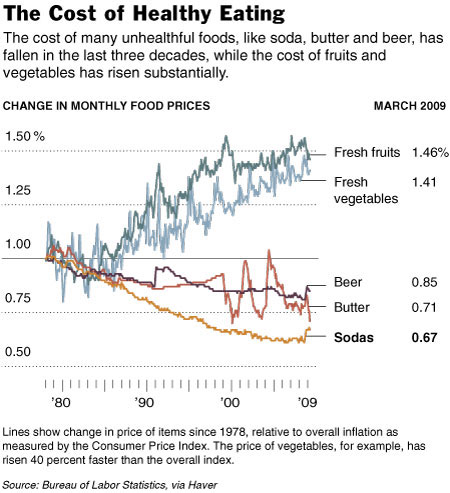
[Sidebar: I recently saw a chart showing that, "The cost of many unhealthful foods, like soda, butter and beer, has fallen in the last three decades, while the cost of fruits and vegetables has risen substantially." This would trigger an entire sidebar discussion about how processed foods are cheaper than less-processed foods and how this plays into the choices that economically disadvantaged people have and so on.]


I hear the same "good"/"bad" talk from people about going to the gym, and it similarly makes me wince.

NBC's TODAY recently had Jillian Michaels from The Biggest Loser on, and I tuned in partway through the segment while I was at the gym. She was talking about "fat talk" and how it's harmful to women. She said that we're socialized to be modest, to not seem too full of ourselves, but at what cost. I think that is true to a degree, but I think there are other reasons why "fat talk" is such a part of female socializing, and I felt like it was almost this elephant in the room. I mean, she's a trainer on a show called The Biggest Loser. Yes, these people are doing intense physical training, but my impression (from listening to my coworkers who do watch the show talking about it -- I've never actually seen the show since the whole premise makes me uncomfortable on multiple levels) is that the deciding factor for who moves on to the next round is a "weigh-in," not how many miles they can jog or how much weight they can bench press or what their resting heart rate is or anything.

When I hear people say, "Oh I really should get back to the gym," it's usually in the context of, "I need to lose weight," and I think that's generally true in our society (especially, though not exclusively, for women). One of my coworkers does talk about how she's so much happier when she's going to the gym regularly -- that she just feels better when she has a regular routine of physical activity -- but mostly the conversations stay on the superficial level of "I need to lose weight."

I was always boggled when coworkers whom I knew went to the gym wanted to take the elevator ("I go to the gym so I don't have to take the elevator"). I want to be able to hoof it up the four flights of stairs from entry level to my office and beat someone who's taking the elevator and not be out of breath. Yeah I'd like to have tighter abs as a purely aesthetic thing, but I am going to the gym because I want my legs and arms and cardiovascular system to be stronger and healthier. It is so much more satisfying to push up the numbers on the speed and incline on the treadmill or on the weights in the strength training room (machines and free weights) than it is to push down the numbers on the scale (and yes, I admit that I've gotten sucked into weighing myself at the gym on average once a week [not that I tell anyone the numbers, but the scale is right there, and numbers are seductive] and I when I hit the upper end of what I think of as my regular range, I get nervous and start paying more attention to my junk food consumption for the next few days*).

*General note on food: I think consuming lots of processed food probably isn't the happiest thing for my body, and I'm trying to train myself to be attentive to what it is that I really want to eat rather than just eating whatever happens to be convenient (and also having more healthy stuff be what is convenient -- fruit, yogurt, Fig Newtons, whatever, instead of Hershey's Kisses or Peanut M&M's), but I'm not gonna feel guilty for downing a whole package of Ferrero Rocher from time to time.

Sweet Machine at Shapely Prose quotes Jane from Casual Blasphemies as saying (re: common mentalities around dieting):
Self-loathing is not a fucking character-builder. It doesn’t make you stronger. It doesn’t make you better. It’s just an ever-deepening, creepy-ass trap; a trap that is a huge moneymaker for corporations that do not have and never will have good intentions. You’re not disgusting. You’re not freakish. You’re not ugly. And you’re never going to be perfect. And holy shit, that is so okay.