Showing posts with label it's the economy (stupid). Show all posts

Tuesday, June 16, 2009

policing the body

Monday morning at the gym, I saw GMA's segment on Marianne Kirby and Gabrielle Gregg.

***

Seen today via Dave Chen: Abercrombie and Fitch banishes girl with prosthetic arm to storeroom because she doesn't fit the "look policy"

***

Yesterday, I was reading a rant about the way Zoe Saldana's skin gets described in fanfic, and in reading something about Zoe Saldana getting described as "light-skinned," I read something (though I can't find it now) that commented that up until recently, being a light-skinned black person meant being the product of a white man raping/coercing a black woman.

***

Marianne Kirby takes issue with Purex's “As things get simpler, they get thinner. They get better.” ad campaign.

***

I read Marianne Kirby's complaint about Bravo's Fashion Show (and an even better blogpost from mo pie on Big Fat Deal) and I remembered something I had seen from Virgina Postrel.

As it turns out, Shapely Prose had already seen Postrel's article.
Sarah: My most charitable read is that she’s distinguishing the average weight from the mean weight. Her argument, as I see it, is that it’s in the economic interests of the clothing companies to make clothes near the mean (rather than the average simply because that’s how they can maximize the number of people who can wear their clothes while minimizing what they spend on developing different sizes.

IOW, even though the “average” size may be a 14, that doesn’t mean that’s the single size (or range of a few sizes) that the greatest number of women can wear. There’s a big range of sizes above a 14, obviously — and those all affect the average size, but that doesn’t mean that any *one* (or two or three) of those plus sizes is common enough to pull in lots and lots of customers, at least to a brick-and-mortar store. So the sizes promising the greatest numbers of customers wouldn’t be the *average* size (or range of sizes), but the *mean* size, which (she claims) brick-and-mortar stores already do try and cater to.
Yes, Sarah, that was my read of it as well (and I wasn't actually going out of my way to be charitable). Shapely Prose links to Jezebel's response to the article, which makes some really good points.

Speaking of fashions for fat ladies, Gabrielle Gregg's YoungFatAndFabulous has lots of pretty pictures (interestingly, I read "Beth Ditto, fashion's Magical Fatty" and then saw Gabi's "Beth for Evans" and "Ditto" posts). Also, I love that the cover model for "Full-Figured Fashion Week" is a hott woman of color.

***

Medical-related readings from today:

Problematizing the obesity=>diabetes stats.

A depressing story from "First, Do No Harm: Real Stories of Fat Prejudice in Health Care."
WLS may increase bone fractures

A small study by the Mayo clinic as reported on Forbes.com showed that one in five people they reviewed after weight loss surgery suffered a bone fracture within 7 years, on average, after having the surgery. The group showed nearly double the fracture rate in post-WLS patients as in other patients.
"We knew there was a dramatic and extensive bone turnover and loss of bone density after bariatric surgery," study senior author Dr. Jackie Clowes, a Mayo rheumatologist, said in a Mayo news release. "But we didn't know what that meant in terms of fractures."
You mean they really didn't realize that an extensive loss of bone density would lead to more fractures? Isn't that, you know, why osteoperosis is a concern in the first place, because the loss of bone density leads to increased fractures? They didn't realize that by putting people through radical surgery that reduced their ability to get proper nutrition might, you know, also prevent them from getting proper nutrition? Like Calcium and vitamin D? That makes for the strong bones? really? Never occured to them?

Wednesday, May 20, 2009

it SPARKLES

I think I'm going to have to boycott Mars candy.

I have SUCH a hate on for stupid stereotyped marketing to women -- which I manage to mostly avoid by virtue of barely watching any tv, but I did get to get all cranky at a CNN(?) feature on this phenomenon some weeks ago while I was at the gym -- but this is so much worse than anything I've seen.

Cara on Feminste writes:
I don’t even know what to do with this one.

Fling is a new chocolate bar that’s aimed at women. You can tell, because the packaging is pink. Also because the damn thing is called “fling,” indicating that there’s something thrilling and “naughty” about the chocolate bar — and no one considers it “naughty” when a dude eats a Snickers. But a Fling only a little naughty — it just has 85 calories! (Which is also how you know it’s for women!) That’s why they didn’t call it Affair.
I remember this stuff from, I think, Jean Kilbourne's books and documentaries -- about how food gets coded as a stand-in for romance/sex/emotional fulfillment (by advertisers) and how we talk about being "bad" (like sinful) when we eat, for example, chocolate.

I started to phrase it as "how our choices about things like food consumption get framed as ethical choices, in both advertising and society," and it occurred to me after I wrote that that our consumption choices are ethical choices in a lot of ways -- did your food have to get trucked in from halfway around the world, thereby adding to carbon emissions? were the workers who helped produced this item compensated fairly? etc. -- but I mean the ways in which we talk about food as being "sinfully good," for example, wherein food and sex and pleasure get all entangled in this dysfunctional thing we blame on our Puritan heritage.

My father commented:
I wonder how much the "Puritan heritage" is the problem and how much is the loss of "religions of sin." Most respectable religion nowadays is relatively sinless. Maybe we have some inherent need to feel we have sinned in various ways, or at least that there is sin out there that needs to be turned around. Thus, the multiplication of more secular sins and guilt: I ate a peach from half-way around the world, "we are raping the earth," etc.

Self-loathing and guilt is exploited by corporations for sales, and by governments for money and power. One small recent example: the report that "Senate leaders are considering new federal taxes on soda and other sugary drinks ..." http://online.wsj.com/article/SB124208505896608647.html
After all, those who drink them should feel ashamed and should have to pay extra for the bad thing they are doing.
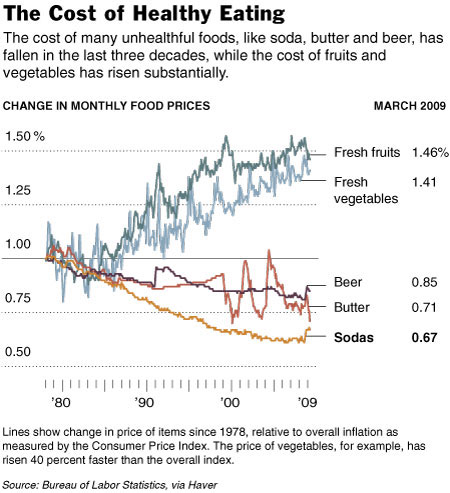
[Sidebar: I recently saw a chart showing that, "The cost of many unhealthful foods, like soda, butter and beer, has fallen in the last three decades, while the cost of fruits and vegetables has risen substantially." This would trigger an entire sidebar discussion about how processed foods are cheaper than less-processed foods and how this plays into the choices that economically disadvantaged people have and so on.]


I hear the same "good"/"bad" talk from people about going to the gym, and it similarly makes me wince.

NBC's TODAY recently had Jillian Michaels from The Biggest Loser on, and I tuned in partway through the segment while I was at the gym. She was talking about "fat talk" and how it's harmful to women. She said that we're socialized to be modest, to not seem too full of ourselves, but at what cost. I think that is true to a degree, but I think there are other reasons why "fat talk" is such a part of female socializing, and I felt like it was almost this elephant in the room. I mean, she's a trainer on a show called The Biggest Loser. Yes, these people are doing intense physical training, but my impression (from listening to my coworkers who do watch the show talking about it -- I've never actually seen the show since the whole premise makes me uncomfortable on multiple levels) is that the deciding factor for who moves on to the next round is a "weigh-in," not how many miles they can jog or how much weight they can bench press or what their resting heart rate is or anything.

When I hear people say, "Oh I really should get back to the gym," it's usually in the context of, "I need to lose weight," and I think that's generally true in our society (especially, though not exclusively, for women). One of my coworkers does talk about how she's so much happier when she's going to the gym regularly -- that she just feels better when she has a regular routine of physical activity -- but mostly the conversations stay on the superficial level of "I need to lose weight."

I was always boggled when coworkers whom I knew went to the gym wanted to take the elevator ("I go to the gym so I don't have to take the elevator"). I want to be able to hoof it up the four flights of stairs from entry level to my office and beat someone who's taking the elevator and not be out of breath. Yeah I'd like to have tighter abs as a purely aesthetic thing, but I am going to the gym because I want my legs and arms and cardiovascular system to be stronger and healthier. It is so much more satisfying to push up the numbers on the speed and incline on the treadmill or on the weights in the strength training room (machines and free weights) than it is to push down the numbers on the scale (and yes, I admit that I've gotten sucked into weighing myself at the gym on average once a week [not that I tell anyone the numbers, but the scale is right there, and numbers are seductive] and I when I hit the upper end of what I think of as my regular range, I get nervous and start paying more attention to my junk food consumption for the next few days*).

*General note on food: I think consuming lots of processed food probably isn't the happiest thing for my body, and I'm trying to train myself to be attentive to what it is that I really want to eat rather than just eating whatever happens to be convenient (and also having more healthy stuff be what is convenient -- fruit, yogurt, Fig Newtons, whatever, instead of Hershey's Kisses or Peanut M&M's), but I'm not gonna feel guilty for downing a whole package of Ferrero Rocher from time to time.

Sweet Machine at Shapely Prose quotes Jane from Casual Blasphemies as saying (re: common mentalities around dieting):
Self-loathing is not a fucking character-builder. It doesn’t make you stronger. It doesn’t make you better. It’s just an ever-deepening, creepy-ass trap; a trap that is a huge moneymaker for corporations that do not have and never will have good intentions. You’re not disgusting. You’re not freakish. You’re not ugly. And you’re never going to be perfect. And holy shit, that is so okay.