Showing posts with label you are what you eat. Show all posts

Saturday, March 13, 2010

[sermon 13] Lent 4C - Called to a Ministry of Reconciliation

Lent 4C - March 14, 2010
Joshua 5:9-12
Psalm 32
2 Corinthians 5:16-21
Luke 15:1-3, 11b-32
Called to a Ministry of Reconciliation

We ARE a forgiven people.

Oh, you want me to say more than that, don't you?
For day and night your hand was heavy upon me; my strength was dried up as by the heat of summer. Selah

Then I acknowledged my sin to you, and I did not hide my iniquity; I said, "I will confess my transgressions to the LORD," and you forgave the guilt of my sin. Selah

(Psalm 32:4-5)
Sin and guilt tire us out.  They weigh heavy on us, and they wear us down.

And when we confess, when we hand all our failings and guilt over to God, we are freed.

I've been leading the Call to Confession at midweek service for some time now, and when I do I talk about God who is always reaching out to us, always desiring to welcome us back.

All we have to do is ask.  All we have to do is turn.

Our Old Testament reading today is from the book of Joshua, and it tells us of the day the manna ceased -- don't worry, this isn't a bad thing.

The children of the Exodus, forty years after the departure from Egypt (during which they were not yet born), have reached the border of the Promised Land.  God tells them, "Today I have rolled away from you the disgrace of Egypt."  The burden of their past has been lifted from them.  God has opened the Promised Land to them.

Had we started at the beginning of this chapter from Joshua, we would have read:
For the Israelites traveled forty years in the wilderness, until all the nation, the warriors who came out of Egypt, perished, not having listened to the voice of the LORD. The LORD had sworn that none of them would see the land promised on oath to their ancestors, a land flowing with milk and honey.  So it was their children, whom God raised up in their place.  (Joshua 5:6-7a)
In that earlier portion of Chapter 5 we would have also read about those who were to enter the Promised Land getting circumcised with flint knives, for they had not been circumcised along the way.  That is some serious dedication.  I'm not sure there's any Promised Land I want enough to go through something like that (provided I were a guy -- I guess their sisters and wives and daughters got a free pass).  And so there is this tension -- God's forgiveness and mercy are always and abundantly available to us, we need only ask for them; but to really share in God's commonwealth requires something additional, something difficult.  It requires that we give up something of our past lives, of our past selves, before we cross this threshold.

Paul writes:
From now on, therefore, we regard no one from a human point of view; even though we once knew Christ from a human point of view, we know Christ no longer in that way.  So if anyone is in Christ, there is a new creation: everything old has passed away; see, everything has become new!  All this is from God, who reconciled us to Godself through Christ, and has given us the ministry of reconciliation; that is, in Christ God was reconciling the world to Godself, not counting their trespasses against them, and entrusting the message of reconciliation to us.  So we are ambassadors for Christ, since God is making God's appeal through us; we entreat you on behalf of Christ, be reconciled to God.  (2 Corinthians 5:16-20)
We are called to the ministry of reconciliation.

Luke tells the story of the prodigal child.  Sometimes we are the prodigal child -- welcomed back into loving arms after having squandered all we demanded as our fair share.  And sometimes we are the elder child -- angry at the largesse extended to an ungrateful turncoat while we have toiled diligently but unacknowledged.

The story of the prodigal child is one of the stories that Jesus tells to answer the authorities who were complaining, "This one welcomes sinners and eats with them" (Luke 15:2).  The parent in the parable -- a stand-in for God -- tells the elder child: "Child, you are always with me, and all that is mine is yours.  But we had to celebrate and rejoice, because this sibling of yours was dead and has come to life; was lost and has been found" (Luke 15:31-32).

God says to the faithful, "You are always with me, and all that is mine is yours."  In the face of that, how can we begrudge anyone else any of God's abundance?

And yet we do.  Over and over again we do.  We have earned what we have -- we have worked hard in the house of our Lord, and how dare these others come in and get a glorious welcome.  We have worked hard within the system, we have earned what we have -- nevermind the privilege of our race, our class, our physical and mental health or ability, our nationality, our citizenship, our sexual orientation, our gender identity or presentation -- so why should all these other people have advantages and access bestowed upon them?  Why should "special accommodations" be made for those with disabilities?  Why should my tax dollars go to paying for health care for undocumented immigrants -- why don't they just go back where they came from?  The list of people we may resent is neverending -- the parent with the screaming child on the T (don't they know how to make their child behave?), the person on the sidewalk asking for spare change (surely they'll just use it to buy drugs), that first-timer who hasn't stopped talking to your pastor all Coffee Hour (don't they know that you're a lifetime member of this church and you have a very important conversation you need to have with the pastor?).  But we are called to a ministry of reconciliation.

Or maybe we are the younger child.  We have been given so many gifts, and we have squandered them, and now there is a famine in our lives, and we don't know where else to turn, so we return to the place from whence we came, desiring only to work unseen somewhere until the famine passes.  The head of the household rushes out to meet us on the way, and we flinch, expecting to be berated for our poor financial planning, our unhealthy life choices -- but instead, we are embraced.  We cry out, "I'm not worthy!" and against our will we are robed in markers of the house, markers of belonging.  God says, "Child, you are my beloved.  Welcome home.  You belong here."  And it is hard for us to believe -- especially with elder siblings sullenly preparing the fatted calf for dinner -- but it is true.  We are God's children; we are part of God's family -- right along with everyone else.  And we are called to a ministry of reconciliation.

The Israelites kept the Passover and on that day they ate of the land -- of the fruit of the land rather than of the manna God had been providing for them throughout their journey.

In eating of the land, they solidify their identity as people of that land -- no longer nomads.

What we eat is important.  And where we eat.  And whom we eat with.

This past Wednesday I heard a Reflection on the part in Paul's first letter to the Corinthians (1 Cor 11:17ff) wherein he berates them for replicating the injustices of the world in their enactment of the agape meal instituted by Jesus at the Last Supper.

This commemoration of the Last Supper was not the mere mouthful of bread and sip of drink that we have today, but a full meal.  And at the church at Corinth, instead of all sitting down together and eating like friends, like family -- people were eating and drinking without regard for each other.  Some indulging to such excess that they go home drunk, while others are going home hungry.

No one should leave Christ's table hungry.

If you're leaving hungry, it is a table not of Christ but of the world.

Whose table do we proclaim in our meals?  The meal we serve at Coffee Hour -- are we attentive to the dietary needs of our congregation?  The grocery shopping we do for the meals we make at home -- are we purchasing food whose production is in keeping with our social values?

We are called to a ministry of reconciliation.  And that means recognizing the interconnectedness of all life -- recognizing our responsibility to help care for all of God's beloved Creation.  And that includes ourselves.  God declares over and over to us, "Today I have rolled away from you the disgrace of Egypt."  We do not need to earn this -- we do not need to do good deeds to offset the less good deeds we have done.  We are called to the hard work of ministry because we are family, but whenever there is a famine in our lives, God is rushing out to meet us, welcoming us back to sit in front of the hearth and eat a bounteous meal with all those who love us.

Amen.

Saturday, August 22, 2009

"More grains. Less you."

Excuse me, WHUT?

I was just channel-surfing 'cause I don't have the energy to think, and there was an ad for whole grain cereal, saying it can help you lose weight ("people who eat more whole grains have a healthier body weight" -- define "healthier body weight") and I'm used to that sort of stuff, but then their tagline was "More grains. Less you." 0.0

Tuesday, June 23, 2009

[policing the body] "uncontrollable appetites" (fat, food)

Last Wednesday (June 17) GMA had MeMe Roth on (whom I had read about the other day via the Notes from the Fatosphere feed). (BigLibertyBlog also blogged about the GMA piece.)

I think even if I hadn't been prepped at all, I still would have been a bit "huh?" at the ridiculously softball nature of the interview. Yes, you don't want junk food to even be an option at "in loco parentis" places, I understand the logic behind that. But what sort of twisted logic is, "So that the kids aren't doing nothing while everyone else is chowing down on junk food, they can pull out a plastic container and put the junk food in that and bring it home and we'll discuss whether they're allowed to have it maybe after their piano lesson or something"? One commenter said, "if MeMe doesn’t want her children to have cupcakes, donuts, and juice pops, she could always just instruct them to politely refuse the treats. There were kids at my elementary school who were taught to do that because of allergies, religious dietary requirements, and parents who had strong beliefs about what foods were good and bad for them, and aside from a question here and a pitying look there, it wasn’t a big deal."

And wtf "Show me an American who understands moderation?" Seriously? We should ban junk food from everyone's presence because no one is capable of consuming in moderation? (And how the eff did obesity rob her mother and grandmother of "their health, and their hope, and their aspirations"?)

And, um, you told the YMCA that if they didn't get some food out in addition to the ice cream buffet in the next hour you were going to start throwing food out? No wonder the cops got called.

A friend of mine sent me this article on MeMe Roth. From the end:
When I ask her if she's ever been anorexic, she gasps: "No! I've never even been on a diet!" So I ask her what she eats in an average day. On this, Roth is reticent. She now runs a private nutrition counselling business, she says, and because of that, "I don't spend a ton of time telling people what I do personally. What works for me may not work for other people."

That's fine, I say, but just as an example?

"I eat beans like nobody's business," she says hurriedly. "I eat more black beans than anyone else I know."

I try to pin her down to something more specific. Let's just do a sample day, I say. What about breakfast? Roth grimaces. "I hate to say this, because I think it's counter to what most people should do, but I never in my whole life have enjoyed breakfast. For me, it doesn't work as well as other things."

Right, I say. So how about lunch?

She squirms visibly. "You're taking me where I don't want to go ... What works for me doesn't work for a lot of people."

Well, you've said that, I insist, so taking that into account: lunch? Roth hesitates. "I discovered when I was in college that I work best when I get a workout in and eat after that. Sometimes I'll delay when I eat until I get a workout in. But I don't let a whole day go by without running four miles."

OK, I go on, but supposing you couldn't work out until four o'clock in the afternoon - would you not eat until after that?

"I might."

I look at my watch. It's 3.30pm. Alarm bells start to ring in my head. How about today, I ask. Have you eaten at all today?

Roth is a little quiet.

"No," she says.

There is a pause.

"But I feel great!"
***

That same day, Sweet Machine complained about the obsessive attention to what President Obama eats. She wrote:
Maybe the very reason that Obama can sometimes just pick at his fries instead of shoving them into the presidential gullet is that he knows he can have fries another day if he likes. The man is the president of the United States, after all. Do we really want him to obsess over whether he should order his salad dressing on the side?

I know that this isn’t the first time that a President’s gustatory preferences have been drummed up into a national incident, but this idea that people will eat themselves fat because the Obamas ate fish and chips—while in London!—is only possible in a culture where we are so deeply alienated from our own bodies that we cannot be trusted to use food. Are you insulted? I sure as hell am.

Wednesday, May 20, 2009

it SPARKLES

I think I'm going to have to boycott Mars candy.

I have SUCH a hate on for stupid stereotyped marketing to women -- which I manage to mostly avoid by virtue of barely watching any tv, but I did get to get all cranky at a CNN(?) feature on this phenomenon some weeks ago while I was at the gym -- but this is so much worse than anything I've seen.

Cara on Feminste writes:
I don’t even know what to do with this one.

Fling is a new chocolate bar that’s aimed at women. You can tell, because the packaging is pink. Also because the damn thing is called “fling,” indicating that there’s something thrilling and “naughty” about the chocolate bar — and no one considers it “naughty” when a dude eats a Snickers. But a Fling only a little naughty — it just has 85 calories! (Which is also how you know it’s for women!) That’s why they didn’t call it Affair.
I remember this stuff from, I think, Jean Kilbourne's books and documentaries -- about how food gets coded as a stand-in for romance/sex/emotional fulfillment (by advertisers) and how we talk about being "bad" (like sinful) when we eat, for example, chocolate.

I started to phrase it as "how our choices about things like food consumption get framed as ethical choices, in both advertising and society," and it occurred to me after I wrote that that our consumption choices are ethical choices in a lot of ways -- did your food have to get trucked in from halfway around the world, thereby adding to carbon emissions? were the workers who helped produced this item compensated fairly? etc. -- but I mean the ways in which we talk about food as being "sinfully good," for example, wherein food and sex and pleasure get all entangled in this dysfunctional thing we blame on our Puritan heritage.

My father commented:
I wonder how much the "Puritan heritage" is the problem and how much is the loss of "religions of sin." Most respectable religion nowadays is relatively sinless. Maybe we have some inherent need to feel we have sinned in various ways, or at least that there is sin out there that needs to be turned around. Thus, the multiplication of more secular sins and guilt: I ate a peach from half-way around the world, "we are raping the earth," etc.

Self-loathing and guilt is exploited by corporations for sales, and by governments for money and power. One small recent example: the report that "Senate leaders are considering new federal taxes on soda and other sugary drinks ..." http://online.wsj.com/article/SB124208505896608647.html
After all, those who drink them should feel ashamed and should have to pay extra for the bad thing they are doing.
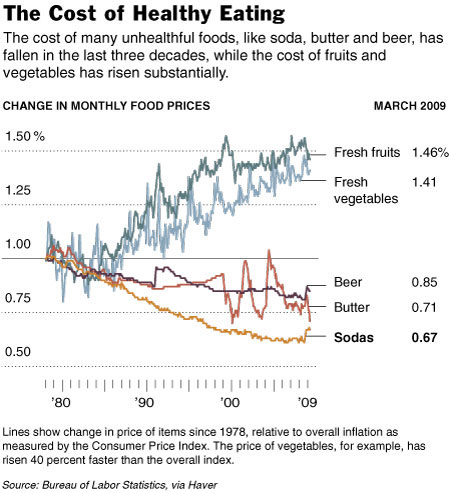
[Sidebar: I recently saw a chart showing that, "The cost of many unhealthful foods, like soda, butter and beer, has fallen in the last three decades, while the cost of fruits and vegetables has risen substantially." This would trigger an entire sidebar discussion about how processed foods are cheaper than less-processed foods and how this plays into the choices that economically disadvantaged people have and so on.]


I hear the same "good"/"bad" talk from people about going to the gym, and it similarly makes me wince.

NBC's TODAY recently had Jillian Michaels from The Biggest Loser on, and I tuned in partway through the segment while I was at the gym. She was talking about "fat talk" and how it's harmful to women. She said that we're socialized to be modest, to not seem too full of ourselves, but at what cost. I think that is true to a degree, but I think there are other reasons why "fat talk" is such a part of female socializing, and I felt like it was almost this elephant in the room. I mean, she's a trainer on a show called The Biggest Loser. Yes, these people are doing intense physical training, but my impression (from listening to my coworkers who do watch the show talking about it -- I've never actually seen the show since the whole premise makes me uncomfortable on multiple levels) is that the deciding factor for who moves on to the next round is a "weigh-in," not how many miles they can jog or how much weight they can bench press or what their resting heart rate is or anything.

When I hear people say, "Oh I really should get back to the gym," it's usually in the context of, "I need to lose weight," and I think that's generally true in our society (especially, though not exclusively, for women). One of my coworkers does talk about how she's so much happier when she's going to the gym regularly -- that she just feels better when she has a regular routine of physical activity -- but mostly the conversations stay on the superficial level of "I need to lose weight."

I was always boggled when coworkers whom I knew went to the gym wanted to take the elevator ("I go to the gym so I don't have to take the elevator"). I want to be able to hoof it up the four flights of stairs from entry level to my office and beat someone who's taking the elevator and not be out of breath. Yeah I'd like to have tighter abs as a purely aesthetic thing, but I am going to the gym because I want my legs and arms and cardiovascular system to be stronger and healthier. It is so much more satisfying to push up the numbers on the speed and incline on the treadmill or on the weights in the strength training room (machines and free weights) than it is to push down the numbers on the scale (and yes, I admit that I've gotten sucked into weighing myself at the gym on average once a week [not that I tell anyone the numbers, but the scale is right there, and numbers are seductive] and I when I hit the upper end of what I think of as my regular range, I get nervous and start paying more attention to my junk food consumption for the next few days*).

*General note on food: I think consuming lots of processed food probably isn't the happiest thing for my body, and I'm trying to train myself to be attentive to what it is that I really want to eat rather than just eating whatever happens to be convenient (and also having more healthy stuff be what is convenient -- fruit, yogurt, Fig Newtons, whatever, instead of Hershey's Kisses or Peanut M&M's), but I'm not gonna feel guilty for downing a whole package of Ferrero Rocher from time to time.

Sweet Machine at Shapely Prose quotes Jane from Casual Blasphemies as saying (re: common mentalities around dieting):
Self-loathing is not a fucking character-builder. It doesn’t make you stronger. It doesn’t make you better. It’s just an ever-deepening, creepy-ass trap; a trap that is a huge moneymaker for corporations that do not have and never will have good intentions. You’re not disgusting. You’re not freakish. You’re not ugly. And you’re never going to be perfect. And holy shit, that is so okay.